Set the headlines aside for a moment. In most growing businesses the AI that earns its keep is dull: it takes the slow reading and the repetitive typing off your team, so customers hear back sooner.
We'd start there, with one job and one team, and skip the company-wide "AI strategy" that nobody can quite explain.
Start with a delay customers can feel
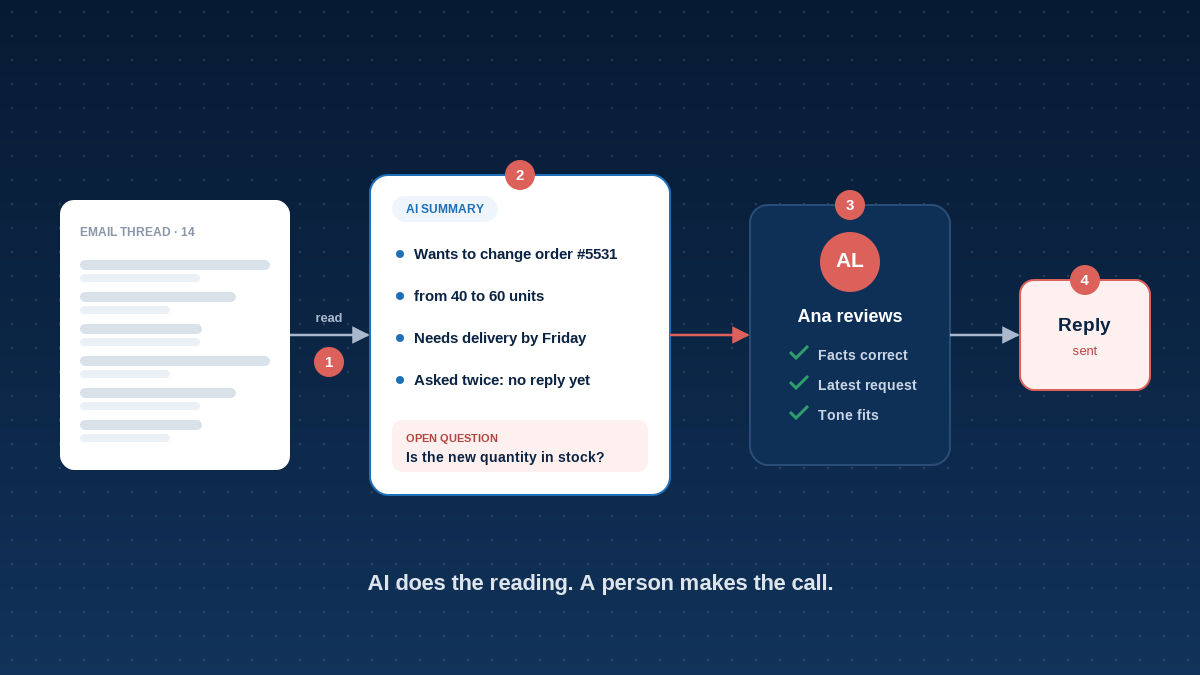
Suppose replies to support emails typically take a couple of days. Trace a few and you'll often find that writing the answer is quick. What eats the time is the reading: someone working back through a twenty-message thread to find out what the customer wants now.
That reading is a good first job for AI. It can boil a long exchange down to a few lines covering the request, what has changed since it started and what is still unanswered. Your team member confirms it's right, then gets on with helping.
Where it tends to earn its keep
| Team | The job AI picks up | What stays with a person |
|---|---|---|
| Sales | Gathers an account's history into a brief before a call | Leading the conversation and making the offer |
| Marketing | Notices the questions customers ask again and again | Choosing what to write about, and how |
| Service | Finds the right how-to and suggests a reply | Checking it, adjusting the tone, sending it |
| Operations | Lifts order details off incoming paperwork | Reviewing anything the system marks as uncertain |
The pattern is the same in every row. AI gets things ready, and a person answers for what reaches the customer.
Run a small, fair trial
- Pick a job with a clear "before". Ask your team which part of their day drags. Good candidates come up many times a week, belong to one team and are easy to time.
- Use real cases, including the awkward ones. Only share information your team is cleared to put into the tool. Alongside the simple requests, add the messy ones, like the order that gets amended twice before anyone replies.
- Make the human role explicit. People need to know they review what the tool produces, correct it, and spot the cases that need a person from the start. One named person keeps the reference material (prices, policies, product details) accurate.
- Count the full cost. Include the minutes spent checking and fixing the output along with the minutes it saved. If customers get correct answers faster and fewer have to follow up, you have the case for going further.
Where it disappoints
It will be wrong sometimes, and it will sound exactly as sure as when it's right. Summaries are the usual place. A customer changes the quantity halfway through a thread and the summary reports the first figure. That is why the checking step stays, especially in the early weeks.
Two other ways a trial fails have nothing to do with the technology. One is buying the tool first and looking for a use afterwards. The other is pointing it at messy records: the output is only as good as the customer data underneath, so get that into one place first.
Your first experiment
Find the question your team answers more than any other, and time how long a good answer takes today. That number is your baseline, and that question is your first test.