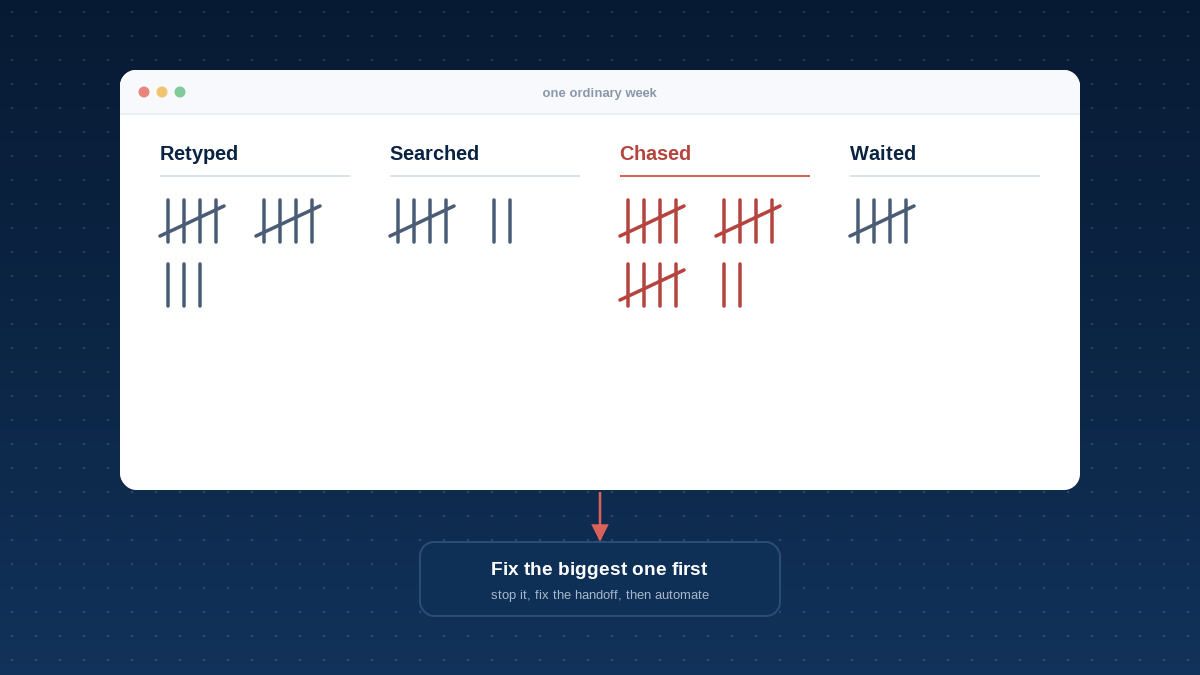
Sales are climbing, the phone rings more, the order queue is longer, and the people doing the work are the same handful who were here three years ago. The obvious answer is another hire.
Sometimes that's right. But a new person takes months to find and train, and if the work itself is wasteful, you've added one more person to do wasteful work. Before the job ad goes out, we'd spend a week finding out where the hours you already pay for are going.
The problem
Busy teams lose time in the gaps around the real work, and it tends to be one of four kinds:
- Retyping. The same order details go into the quote, then the accounting system, then a spreadsheet for the warehouse.
- Searching. Someone scrolls a shared inbox to find out what was promised and when.
- Chasing. Someone walks over, or sends a message, to ask a colleague where a job stands.
- Waiting. A job sits because an approval or an answer hasn't come back, and nobody is sure whose desk it's on.
None of it feels like much, because each one takes two minutes. It's the count that hurts, and because it never shows up as a line on a report, nobody is asked to fix it.
How to find it
We wouldn't begin with software, or with a consultant, us included. We'd begin with a tally.
For one ordinary week, give everyone a sheet with those four headings and ask them to make a mark each time they retype something, go looking for something, chase someone, or stop because they're waiting on someone. Marks only, with no timing and no names on a leaderboard. (If it feels like surveillance, people stop marking by Tuesday.)
On Friday, add them up together. The picture will probably be lopsided, with one or two chores collecting most of the marks. Those are your candidates.
What to do with the biggest one
Take the top chore only, and ask three questions in this order.
- Can we stop doing it? Some double entry and some reports exist because someone asked for them years ago and nobody has checked since.
- Can we fix the handoff? If people chase because nobody is sure whose job comes next, the cure is a rule written down and agreed, which costs nothing.
- Can a system do it? This question comes last on purpose. It's where a shared customer record, a couple of automations or a connection between two systems earns its place.
The order matters, because automating a step you could have deleted is the most expensive way of keeping it.
Where this isn't perfect
The tally undercounts. People forget to mark, and the worst chores are so habitual that nobody sees them as waste any more. Treat the totals as a direction and don't quote them as a measurement.
And sometimes the honest answer is that you do need another person. If the sheet comes back nearly empty and the team is still underwater, hire.
Try it this week
Print a sheet with four columns (retyped, searched, chased, waited), run it for five working days, and look at it together on Friday afternoon.